Term Premium on a 10-Year Zero Coupon Bond

Term Premium on a 10-Year Zero Coupon Bond Term premium on a 10-year zero coupon bond remains in negative territory. Investors do not seem to fear rising rates over the long-term. The term premium is the risk premium (or the bonus) that investors receive for the risk of owning longer-term bonds.

U.S. Unemployment Rate: Black or African Americans

U.S. Unemployment Rate: Black or African Americans The U.S. unemployment rate of Black or African Americans stands at 6.3%, while the civilian unemployment rate stands at 3.7%, near its lowest level in almost 50 years. You may also like “Homeownership Disparity Deepens.”

Longest Losing Streak for Global PMI

Longest Losing Streak for Global PMI Global PMI falls for 15 months in a row. New tariffs will certainly not help. Image: Charles Schwab

U.S. Leading Economic Indicators and Recession Warnings

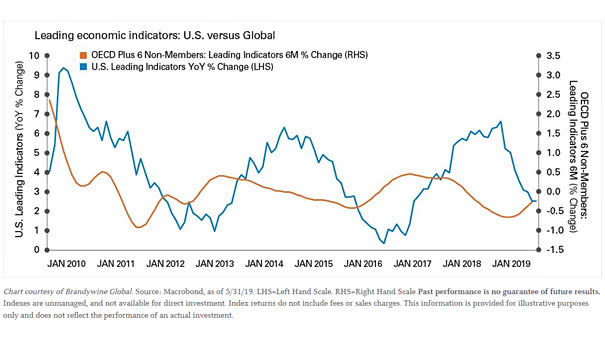
U.S. Leading Economic Indicators and Recession Warnings The Conference Board’s Leading Economic Index for the U.S. has rarely weakened sharply ahead of rate cuts, except in 2007. Currently, it doesn’t suggest that a recession is looming. Image: Reuters

Fed Funds Target Rate and VIX

Fed Funds Target Rate and VIX Is more volatility expected ahead? This great chart suggests that the Fed funds target rate leads VIX by 2 years. You may also like “VIX is in a Transitory State” and “The Yield Curve Leads Volatility by Three Years.” Image: Bloomberg, Jeffrey Kleintop

How Does A First Rate Cut Affect the Stock Market?

How Does A First Rate Cut Affect the Stock Market? Since 1970, the first rate cut has been bullish for the S&P 500 for the next 12 months, with recession and no recession. Image: Fidelity Management and Research

U.S. Long-term Unemployment Rate

U.S. Long-term Unemployment Rate Interesting chart showing that the U.S. long-term unemployment rate is back to its long-run average. Image: Ben Casselman

U.S. Unemployment Rate and Wage Growth

U.S. Unemployment Rate and Wage Growth U.S. unemployment rate at 3.7% and U.S. wage growth at 3.2% in July. U.S. employment growth slows, suggesting the U.S. economy is cooling. Image: Jeroen Blokland